
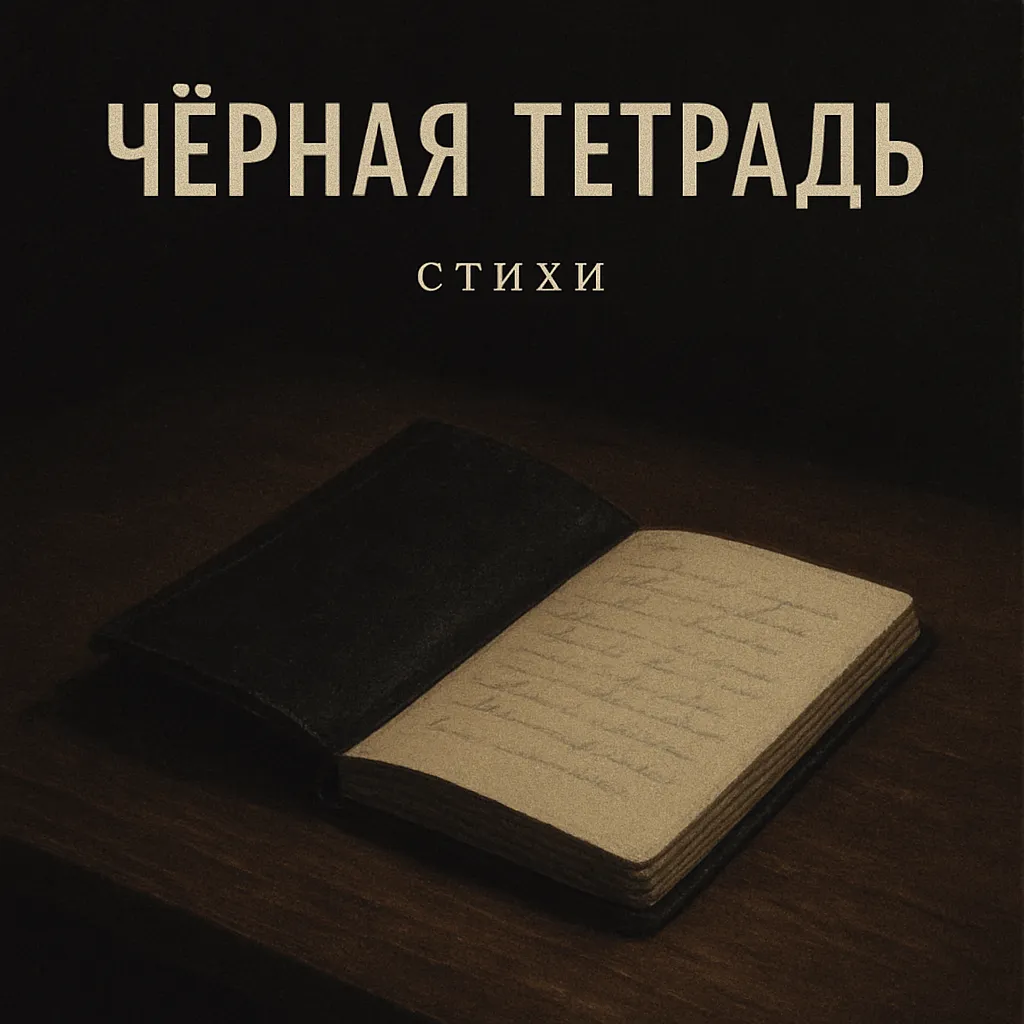

The title says it plainly: these were poems not meant to be read. A black notebook is where you write what you don't plan to show anyone — the words you need to exist somewhere outside your head, but not anywhere visible. The six poems collected here were all written between September and December 2008, across a single autumn season. For years they stayed private. That privacy is built into them.
What the collection is about is not quite what it appears to be about. On the surface, each poem concerns a person, a relationship, a summer that ended. But the real subject running through all six is memory itself — specifically, the problem of memory that refuses to cooperate. The speaker of these poems cannot forget, cannot move on, cannot stop loving even when he has decided to. The poems are written not from heartbreak but from its aftermath: the strange persistence of feeling past the moment that produced it.
The temporal structure is the collection's most consistent device. "А я тебя любить так и не перестал..." is explicit about the distance: three years have passed since the feeling it describes. "Остался только образ..." reaches back to a girl at fifteen, years before 2008. "Просто не могу забыть" recalls a summer it calls "my magical world." In each case, the poem is written from the present but about a past that hasn't become past. The emotional project of the collection is: I know this is over; I cannot make myself believe it.
"Остался только образ..." makes this dilemma structural. It opens and closes with the same two lines — "Only an image remained in my memory / Of a beautiful girl around fifteen years old" — and everything between is the act of writing the poem itself: the apology for writing it, the admission that writing is the only way this memory can be addressed. The poem knows it shouldn't linger, and so it lingers once more, in verse, and then seals the loop.
The most compressed poem in the collection is also its most honest about failure. "Впредь никому я чувства не открою..." builds four-line walls: feelings will no longer be shared, silence is better than exposure, youth only torments the heart. Then it ends:
Блестит прозрачная слеза поэта... Я буду помнить, буду помнить наше лето.
"The poet's clear tear shines... I will remember, I will remember our summer." The preceding poem is the attempt to close a door. The last two lines prove the door won't close.
The collection's most unusual formal device appears in "Ярко жизнь теряю...". The entire poem is built around negation: "not you again with me, not you loving me, not I who flew with you." The person being addressed is named by their absence — present in every "not you," summoned by the refusal to name them. It is a technically accomplished trick for a poet who was twenty years old.
"Прекрасной незнакомке" — the train encounter with a stranger — stands apart from the others in tone and register. It is addressed with the formal Вы rather than the intimate ты used throughout the rest of the collection. It appeared later in the Романтика album, where it fits naturally among poems about unreachable connection. Here it serves a different function: a brief, lighter encounter set among heavier subjects, a reminder that the autumn of 2008 was not only grief.
The closing poem, "Просто не могу забыть", names what the whole collection has been doing:
Повернуть вспять время нет поэта сил, Потому и образ, и мой стих — печальный...
"The poet's force cannot turn time back — that's why the image, and my poem, are sad." Not tragic. Not bitter. Sad. The collection as a whole earns that tone. These are not poems of despair; they are poems of persistence — the persistence of feeling past the moment that caused it, and the ongoing inability, or unwillingness, to be finished with it.
These six poems stayed in the notebook because they were too personal to publish and too true to discard. What makes them worth reading now is precisely what made them unpublishable then: they don't perform their grief for an audience. They are addressed to specific people about specific summers, and the specificity is the point. The black notebook held them because that was the right place for them. That they are here at all is a small act of trust.